Have you ever walked into someone’s house and instantly felt like you understood exactly who they are? That isn’t magic; it is the power of environmental profiling. In 2026, the sterile, entirely gray minimalist aesthetic is officially stepping aside. In its place is a vibrant, deeply personal trend that interior designers are calling “Dopamine Decor.”
But dopamine decor psychology goes far beyond just painting a wall yellow or buying a funky lamp. The way we structure our physical environment is a direct mirror of our internal cognitive state.
By understanding the principles behind this trend, you can not only design a space that actively boosts your mood, but you can also learn how to read a room—and the person who lives in it—within seconds of walking through the door.
What Exactly is Dopamine Decor?
At its core, dopamine decor is an interior design style focused on triggering the brain’s reward center. It prioritizes joy, nostalgia, and personal expression over strict aesthetic rules.
Instead of hiding personal items away in sleek storage units to achieve a “clean” look, this trend encourages displaying the things that make you inherently happy. It is characterized by:
Vibrant, saturated color palettes (think mustard yellows, deep terracottas, and emerald greens).
Biomorphic shapes (furniture with soft, organic curves instead of harsh angles).
Tactile layering (mixing velvet, chunky knits, and smooth ceramics).
When you understand dopamine decor psychology, every living room becomes a behavioral map. People subconsciously project their emotional needs and cognitive habits onto their physical surroundings.
Here is how to decode the hidden language of interior design.
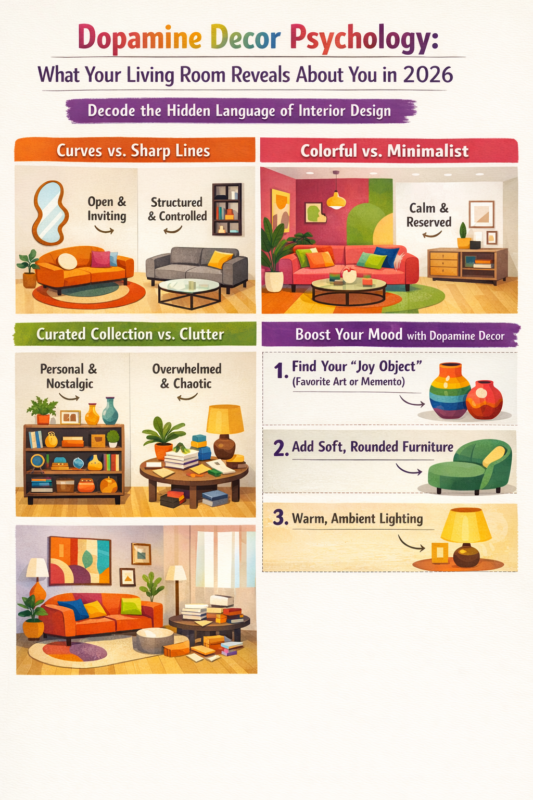
1. Sharp Lines vs. Curved Edges (Rigidity vs. Openness)
Take a look at the furniture in a room. Does the space rely heavily on sharp, right angles, glass tables, and rigid, low-profile sofas? This often points to a mindset that heavily values order, predictability, and control. This person likely thrives on logic and structured routines.
On the flip side, a room embracing dopamine decor will feature curved sofas, rounded rugs, and asymmetrical mirrors. In behavioral psychology, soft, biomorphic shapes signal approachability, high openness to new experiences, and a desire for social fluidity rather than rigid boundaries.
2. Color Drenching vs. Stark White (Emotional Expression vs. Control)
Color is one of the fastest ways to gauge emotional baseline. A room that is entirely monochromatic (stark white, beige, or gray) is often a subconscious attempt to reduce sensory input. The homeowner might have a high-stress career or a chaotic internal life, utilizing their home as a visual “mute button” to regain a sense of calm control.
Dopamine decor utilizes “color drenching”—painting the walls, trim, and sometimes the ceiling in a rich, enveloping hue. A person who utilizes bold, contrasting colors is typically highly expressive, comfortable with drawing attention, and actively seeking external stimulation to maintain their energy levels.
3. The Clutter vs. Curation Divide
It is a common misconception that dopamine decor equals clutter. There is a massive psychological difference between the two.
True clutter—piles of mail, unorganized items, and blocked walkways—often indicates cognitive overload, procrastination, or elevated anxiety. The brain is too overwhelmed to categorize the physical environment.
Dopamine decor, however, relies on curation. A “maximalist” shelf filled with fifty distinct, carefully placed vintage items shows high intentionality. This person is highly nostalgic, values storytelling, and uses their external environment as an anchor for their personal identity.
How to Apply Dopamine Decor in Your Own Home
You don’t need to completely overhaul your living room to benefit from dopamine decor psychology. Small, intentional changes can significantly shift your daily mood.
Step 1: Identify Your Anchor Object Find one item you already own that brings you immense joy—a piece of art, a colorful rug, or a vintage chair. Place it in your direct line of sight from where you sit most often.
Step 2: Soften the Edges If your room feels too rigid, introduce curves. Swap a square coffee table for a round, nesting set. Add a circular, textured throw pillow to a highly structured sofa.
Step 3: Play with Lighting Harsh, overhead lighting creates a clinical atmosphere. Use multiple, low-level light sources (like amber-toned table lamps) to create a warm, inviting environment that signals to your nervous system that it is time to relax.
Final Thoughts on Modern Design
Your home is more than just a place to sleep; it is a living, breathing extension of your mind. By embracing the principles of dopamine decor, you can create a space that doesn’t just look ready for a magazine cover, but actually functions as a daily catalyst for joy and emotional well-being.
Next time you step into a new environment, take a second look. The walls really are talking—you just have to know how to listen.