For the past decade, a “smart home” looked like a sci-fi movie set. It was defined by glowing screens on refrigerators, bulky cameras on shelves, and voice assistants sitting prominently on coffee tables. We were surrounded by tech that constantly demanded our attention.
But in 2026, the ultimate luxury in interior design is complete technological silence. The new standard is invisible smart home technology 2026.
We are moving away from reactive gadgets that we have to command, and stepping into the era of “ambient intelligence”—homes that are designed to silently observe our habits, anticipate our needs, and seamlessly blend into our aesthetic without a single wire showing.
Here is why the invisible smart home is taking over, and how it acts as a masterclass in behavioral observation.
From Reactive Commands to Behavioral Profiling
Early smart home technology was purely reactive. You had to press a button on your phone or yell a command across the room to turn off a light. It was convenient, but it wasn’t truly “smart.”
Invisible tech, however, operates on the principles of behavioral profiling. Much like how you might learn to read a person by observing their daily habits and micro-expressions, modern smart homes establish a “baseline” of your behavior.
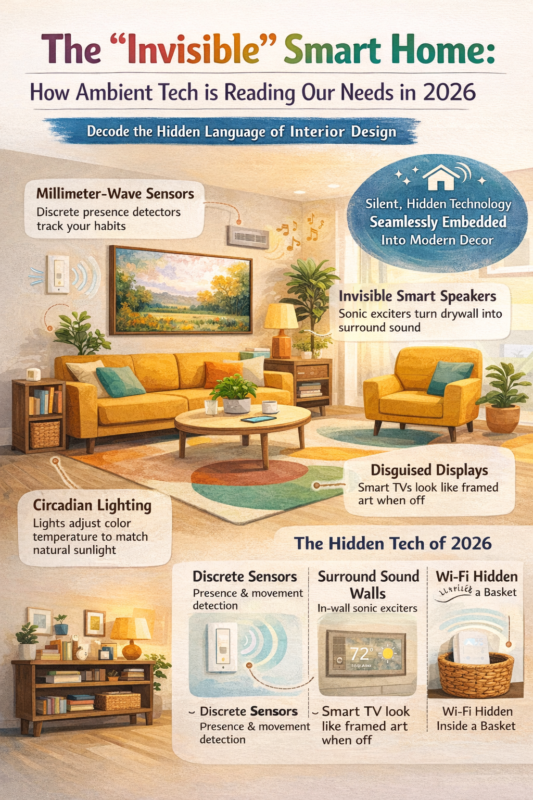
Using millimeter-wave presence sensors hidden inside light switches or behind drywall, the home tracks the subtle rhythms of your day:
Pacing and Movement: The home knows when you are rushing to get ready for work versus when you are slowly pacing the living room to relax.
Environmental Triggers: It learns that when the room temperature drops below a certain degree, you typically reach for a blanket, so it preemptively adjusts the climate control before you even consciously register feeling cold.
By silently gathering this data, the home begins to anticipate your actions. It isn’t magic; it is simply flawless behavioral observation applied to architecture. It gives the illusion that your house can read your mind.
The Aesthetic of the Invisible Smart Home
So, how do you integrate this advanced technology without ruining your carefully curated decor? The secret is embedding function into the architecture itself.
If you are planning an upgrade, here are the hallmarks of invisible smart home technology in 2026:
1. Architectural Audio
Gone are the days of placing bulky black speakers on your bookshelves. The current trend utilizes sonic exciters—devices that install behind your drywall and turn your actual walls into high-fidelity speakers. The sound is immersive and completely invisible, allowing your art and furniture to remain the focal point of the room.
2. Disguised Displays
When a screen is necessary, it shouldn’t look like a screen when turned off. Televisions that mimic framed, matted artwork (complete with realistic canvas textures) are becoming the standard. Smart mirrors in the bathroom display your daily schedule and weather while you brush your teeth, then vanish completely, leaving just a sleek reflective surface.
3. Circadian Lighting
Instead of smart bulbs that you change via an app, invisible lighting systems operate in the background. They are programmed to mimic the exact color temperature of the sun outside. They shift to a bright, cool blue-white in the morning to trigger cortisol and wake you up, and slowly transition to a warm, amber glow by evening to signal to your brain that it is time to produce melatonin.
The Psychology of Hidden Tech: Reducing Cognitive Load
Why is there such a massive push to hide our technology? It comes down to cognitive load.
Every blinking light, tangled wire, and glowing screen is a piece of visual data that your brain has to subconsciously process. In a world where we are constantly bombarded with digital notifications, our homes need to serve as a visual sanctuary.
When technology is visible, it subtly reminds us of work, communication, and obligation. By making technology invisible, we eliminate that visual friction. The home still provides all the comfort, security, and automation we desire, but it allows our nervous system to completely power down.
How to Start “Hiding” Your Tech Today
You don’t need to tear down your drywall to start embracing the invisible smart home trend. You can start reducing your home’s digital footprint this weekend:
Audit Your Wires: Use cable management boxes and paintable cord covers to hide every single TV and lamp wire. The psychological relief of a wire-free space is immediate.
Switch from Voice to Motion: Stop yelling at your voice assistants. Swap out your standard bulbs for motion-activated smart switches in high-traffic areas like hallways and bathrooms.
Hide Your Hubs: Place your Wi-Fi routers and smart home hubs inside decorative woven baskets or behind books on a shelf. As long as they have ventilation, they don’t need to be seen.
The future of home decor isn’t about showing off how much technology you have. It is about how brilliantly you can make it disappear.