
Step into one of today’s wellness-focused luxury homes and you’ll notice the light before you notice the marble. It’s amber and soft in the early morning. It turns crisp and almost clinical by noon. Then it eases back to an ember glow once the sun goes down, and nobody touches a switch to make it happen. This is circadian lighting, and it’s become one of the most requested features in high-end residential design. The good news: you don’t need a six-figure budget. A DIY circadian lighting setup can replicate most of the real benefit for around $300, using the same science the luxury brands rely on.
The official route — Lutron Ketra or Crestron’s human-centric lighting line — starts at $15,000 for a single zone. A full-home install with proper fixtures, processors, and a week of technician labor can run past $50,000.
Here’s what most installers won’t tell you: the science behind these systems isn’t proprietary. It’s published, well-studied, and free to use. This guide covers what the luxury systems actually do, why they cost what they cost, and how to build a comparable DIY circadian lighting setup with off-the-shelf smart home hardware.
What You’re Paying For With Ketra or Crestron
Before copying anything, it helps to know what a lighting designer is actually specifying when a Ketra system shows up on a quote.
Ketra: Treating Light Like an Instrument
A Ketra fixture doesn’t just dim. It shifts color temperature and spectral output using four to six separate LED color channels. Compare that to the two channels in a typical tunable-white bulb. The extra channels let the fixture reconstruct something close to the real spectral fingerprint of sunlight at a given hour, instead of faking the color.
To get there, installers run each fixture through a calibration process using an on-site light meter, matching output against a reference solar curve. The light doesn’t just look like 2700K or 5000K. It behaves that way biologically, because the part of the spectrum tied to melanopic (non-visual, circadian) response gets tuned specifically — not just the visible color.
Crestron’s Approach
Crestron generally isn’t building bulbs. It’s building the automation layer that sits on top of tunable fixtures, whether Ketra or something else. You’re paying for a real astronomical clock that calculates actual sunrise and sunset for your property’s coordinates, shading systems that move in sync, and room-by-room logic that knows a home gym should stay brighter later into the evening than a bedroom.
Where the $50,000 Actually Goes
- Fixtures run $200 to $600 per bulb, and a full home can need dozens
- Processors and hubs typically cost $2,000 to $5,000 each; larger homes need more than one
- Commissioning takes real skilled labor — technicians calibrating individual fixtures and programming automations can log 20 to 40 hours
- Integration ties lighting into shading, HVAC, and audio so the whole house moves as one scene
- Design consultation maps the schedule to how the homeowner actually sleeps and works
None of that is a rip-off. It’s careful engineering. But the biological principle actually delivering the benefit is something you can recreate for a fraction of the cost with a DIY circadian lighting build.
The Actual Science Behind the Kelvin Shifts
This isn’t wellness marketing dressed up in a lab coat. There’s a documented mechanism behind it.
In 2002, researchers identified a set of retinal ganglion cells wired directly into the brain’s circadian clock that respond to light on their own, even when rod and cone input is blocked entirely (Berson et al., Science, 2002). These cells respond most strongly to short-wavelength blue light, roughly 460–480nm. That’s why blue-heavy light at 8am makes you feel alert, and the same light at 10pm quietly delays melatonin release and pushes back your bedtime. The National Institute of General Medical Sciences has a solid plain-language rundown of how this system works if you want to dig deeper.
How the Kelvin Curve Runs Through the Day
A reasonable schedule looks something like this:
| Time of Day | Color Temperature | What It’s Doing |
|---|---|---|
| Sunrise (6–8 AM) | 2200K–2700K, climbing | Soft wake-up cue, barely touches melanopic response |
| Mid-morning (8–11 AM) | 3500K–4500K, climbing | Ramping alertness |
| Midday (11 AM–3 PM) | 5000K–6500K | Peak alertness, strongest melanopic stimulus |
| Afternoon (3–6 PM) | 4000K–5000K, dropping | Keeps focus up without overdoing it |
| Evening (6–9 PM) | 2700K–3000K, dropping | Signals wind-down |
| Night (after 9 PM) | 2000K–2200K or amber only | Barely disrupts circadian rhythm |
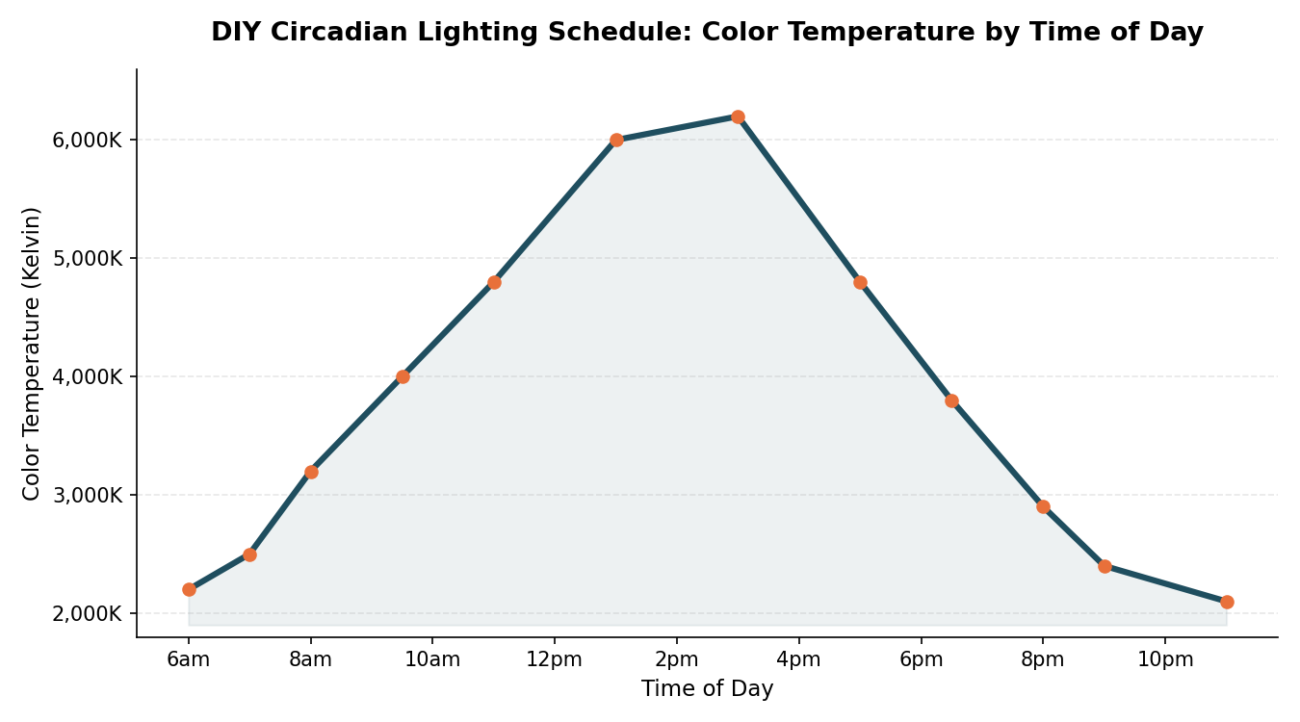
The luxury systems hit this curve with dozens of intermediate steps and full spectral control. A DIY circadian lighting setup hits the same biological checkpoints, just with a rougher, stair-stepped transition.
Where the Research Actually Stands
Worth being honest instead of overselling it. The peer-reviewed work on light and circadian rhythm supports the idea that timed exposure to bright, blue-leaning light in the morning and dim, warm light at night shifts circadian phase and improves sleep quality. What isn’t nailed down is the exact dose-response relationship for ordinary room lighting. Most foundational studies used controlled light-box exposure, not ambient light bouncing around a living room. The broad strategy holds up well; the minute-by-minute schedules some brands market are more design heuristic than clinical protocol.
Building the $300 DIY Circadian Lighting Setup
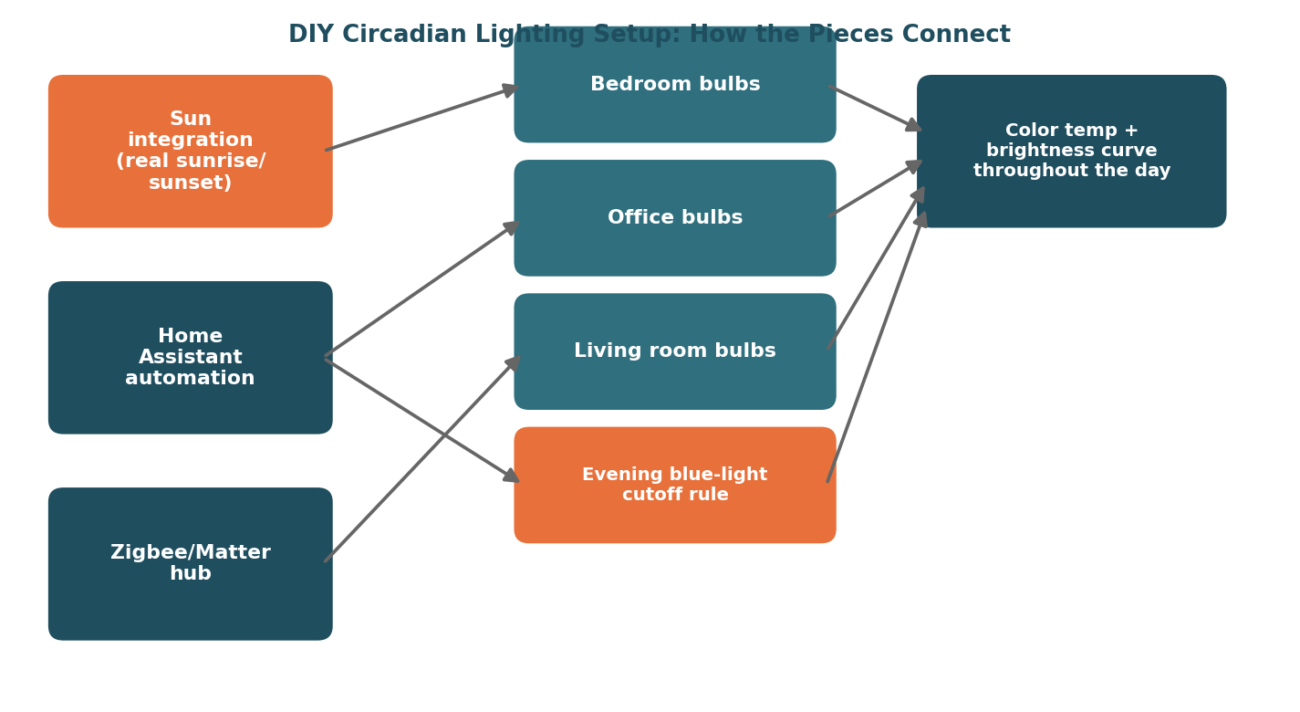
Here’s a full parts list and walkthrough using Matter or Zigbee tunable-white bulbs, run through Home Assistant or Apple HomeKit.
What to Buy (roughly $280–$320 total)
- 8 to 10 tunable-white smart bulbs (2200K–6500K): budget options like Ikea Tradfri or Sengled run $12–18 each; sturdier options like Aqara or Sonoff run $18–25. Figure $150–200 total
- A Zigbee or Matter hub, if you don’t already have one — a SkyConnect dongle or Aqara hub runs $25–40
- Home Assistant, free if self-hosted on a spare Raspberry Pi (about $60–80 if you need one), or run in Docker on a machine you already own
- A basic lux or color sensor, optional, around $20, for closed-loop automation
This setup skips the full-spectrum, multi-channel LEDs that partly justify Ketra’s price. It sticks with standard two-channel bulbs that move only along the warm-to-cool axis instead of reconstructing a real solar spectrum. For the main event — the melanopic effect tied to color temperature and brightness — that trade-off is reasonable, and the research backs it up. (If your site has a broader smart-home buying guide, link it here — for example: our smart bulb buying guide.)
Step 1: Get Home Assistant Running
If you’re comfortable with a little technical setup, Home Assistant OS on a Raspberry Pi is the more capable free route. You get full control over automation logic, no cloud dependency, and compatibility with nearly every smart bulb brand on the market. HomeKit sets up faster but gives you less granular scheduling unless you add a Shortcuts automation on top.
Step 2: Pair the Bulbs and Group Them by Room
Group bulbs logically — bedroom, office, living room — since each space wants a slightly different curve. An office might reasonably stay cooler later into the afternoon than a bedroom.
Step 3: Build the Sunrise/Sunset Automation
This is the piece that makes a DIY circadian lighting setup feel alive instead of just following a fixed clock. Home Assistant’s built-in sun integration calculates real sunrise and sunset for your exact coordinates — the same underlying concept Crestron charges thousands for.
A simple automation looks like this:
- Trigger on sunrise, solar noon, and sunset, calculated live by the
sunentity, plus a couple of fixed-time triggers in between for smoother transitions - Action: at each trigger, call
light.turn_onwith acolor_temp_kelvinandbrightness_pctvalue from the table above - Transition: set the
transitionparameter to roughly 1800 seconds (30 minutes) so the shift eases in instead of snapping
For something closer to a continuous curve, a template-based automation that recalculates color temperature every 15–30 minutes gets you a finer stepped approximation.
Step 4: Cap Blue Light in the Evening
Pick a hard cutoff, commonly 90 minutes before your target bedtime. After that point, every automation caps out at 2200K regardless of what else triggers. This single rule captures most of the actual sleep benefit people are chasing.
Step 5: The No-Code HomeKit Route
If Home Assistant sounds like more setup than you want, Apple HomeKit paired with Matter-compatible bulbs gets you close. Use the Home app’s sunrise/sunset automations, combined with four to six manually built scenes (Morning, Midday, Evening, Night) tied to fixed times or sun-relative offsets. It’s coarser than a continuous curve, but it captures the core logic of DIY circadian lighting with almost no setup work.
What You’re Actually Giving Up at the Budget Tier
| Ketra/Crestron ($15k–$50k+) | DIY Matter/Zigbee (~$300) | |
|---|---|---|
| Spectral accuracy | Multi-channel, matches real solar spectrum | Two-channel warm/cool blend |
| Melanopic precision | High, calibrated to real biological response | Approximate, using color temperature as a proxy |
| Automation detail | Continuous, professionally set up | Stepped, DIY-configured |
| Build quality | Designer fixtures, invisible integration | Standard bulb shapes |
| Whole-home scenes | Tied to shading, audio, and HVAC | Doable with more DIY effort |
| Core circadian benefit | The full effect | Roughly 80–90% of it in practice |
The extra tens of thousands mostly buy spectral precision, invisible design integration, and zero setup effort. The mechanism actually doing the biological work — bright and cool by day, dim and warm by night, timed to your real sunrise and sunset — is something anyone can build with off-the-shelf hardware and one evening of tinkering.
For most people chasing better sleep and fewer foggy mornings, a DIY circadian lighting setup delivers nearly all of the real-world benefit. (A natural spot for an internal link to a related sleep or smart-home post on your site, e.g. how blue light affects sleep.)
If you build this, give it two or three weeks before judging whether it worked. Circadian shifts happen slowly, and you’ll usually notice it first in how fast you fall asleep and how groggy you feel in the morning — not in anything dramatic on day one.
This content discusses sleep and light exposure for general informational purposes and isn’t medical advice. If you have a diagnosed sleep disorder, talk to a doctor before changing your light exposure routine.